



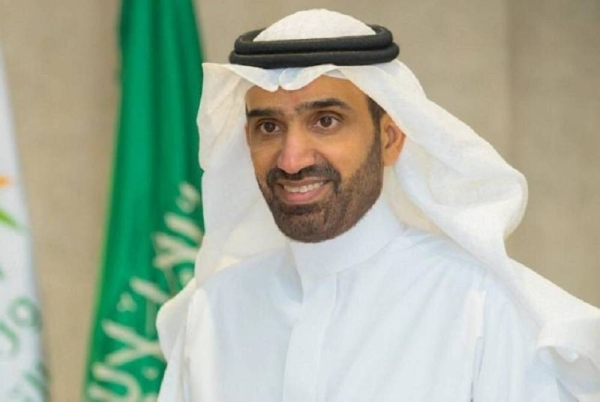
RIYADH — Minister of Human Resources and Social Development Eng. Ahmed Al-Rajhi launched five qualitative initiatives for developing skills and providing training for Saudi cadets. The minister said the ministry looks forward to creating 2.31 million training opportunities in the private sector by end of 2025
He also announced the National Training Campaign (Waad) with the aim of stimulating the private sector to provide training to Saudis. “The promises of commitment to training reached 1,155,000 training opportunities until the end of 2025, through the participation of 14 Saudi companies,” he said.
In a ceremony held in Riyadh on Monday to launch the initiatives, the minister highlighted the support of Custodian of the Two Holy Mosques King Salman, and Crown Prince and Prime Minister Mohammed bin Salman for the empowerment of human resources and social development system as well as for providing more training opportunities and developing future skills for the sons and daughters of the country and raising their participation in the labor market.
Al-Rajhi said that the ministry’s skills and training initiatives include the ‘National Program to Stimulate the Private Sector’ initiative to train its employees, as well as students and graduates. “This initiative targets one million training opportunities by the end of 2025 as previously scheduled. With the launch of the Waad campaign, we have reached 1,155,000 training opportunities in the private sector, and we look forward to doubling the number by the end of 2025.”
The minister said that there is also another initiative to establish sectoral councils for skills in partnership with the private sector targeting 12 sectoral councils as well as the initiative to build national occupational standards for more than 300 professions, in addition to the skills accelerator initiative to develop high-level skills for national cadres and raising their productive efficiency, targeting 162,000 employees in the private sector. The ministry also introduced a training coupon initiative for developing low and medium-level skills for Saudi cadres, which aims to raise the skills of more than 160,000 Saudi employees in the private sector.
The minister noted that the launch of Waad will motivate the private sector to train, according to seven criteria for joining the campaign, the most important of which is training more than 12 percent of Saudi private sector employees annually.
In his speech, Deputy Minister of Human Resources and Social Development for the Labor Sector Dr. Abdullah Abuthunain reviewed the details of the initiatives and their impact on enhancing the participation of national cadres in the labor market. He also praised the efforts and support of partners in the private sector in providing training programs to enhance competitiveness.
Dr. Ahmed Al-Zahrani, undersecretary at the ministry for skills and training, addressed the efforts of the partners in the Waad campaign and the link to register in the campaign, inviting the rest of the partners to join the campaign.
After that, Minister Al-Rajhi received the training commitment agreements from the companies to start a new phase of developing future skills for the sons and daughters of the nation.
The ceremony was attended by the Chairman of the Board of Directors of the Capital Market Authority Muhammad Elkuwaiz, Director General of the Institute of Public Administration Dr. Bandar Al-Sajjan, Chairman of the Board of Directors of the Education and Training Evaluation Authority, Dr. Khaled Al-Sabti, Deputy Minister of Human Resources and Social Development for the Civil Service Eng. Maher Al-Qasim, and a number of officials.
…